Showing posts with label Natural history. Show all posts

Saturday, 17 August 2013

Aesculus problems and Arbutus unedo

Plastic Bags

Fruit of the strawberry tree (Arbutus unedo) - inspiration for the Christmas bauble?
      The daftest, wide-spread public habit of the moment can be seen on almost any pleasant leafy walk: some 'responsible' dog owners have gone to the trouble of taking plastic bags on their daily stroll, collecting the dog's excreta in them, then flinging them into the hedgerow or nearby trees. For a moment you think Christmas has come early and the decorations are already up, until a closer look discloses the unbelievable truth.

      I can see how it happens that lazy people, or those who shudder at the thought of physical contact with dog poo, even through the medium of plastic, will be irresponsible and leave it where it lands. At least it eventually breaks down and goes back into the soil or gets spread out via the crevices of my shoe. However, to go to the trouble of doing the lifting, then preserving it for highly visible posterity, seems a symptom of insanity. My advice to these misguided individuals is to do something creative, like throwing it at a banker.

      The thought of this leads me to the first Christmas of my married life: my mother was coming for  dinner and my wife was desperate to make the right impression by cooking a meal to be remembered. All was going well. The house was in pristine condition, having been Hoovered and dusted, there was a pervasive aroma of roasting turkey, the Christmas tree twinkled with a tasteful set of lights and the home-made decorations put the finishing touches to the aura of festive cheer. We were sitting in the living-room enjoying a pre-dinner sherry (sherry was a lot more fashionable then - it was even an essential aperitif to a restaurant meal, where they would serve schooners of it) - and we were chatting amicably when there was a loud explosion from the direction of the kitchen and the fairy fell off the Christmas tree.

      Resisting the temptation to get under the table, which was the government's advice for surviving a nuclear attack in those days (they had overlooked the fact that our table came from M.F.I.), I crept into the kitchen, to find the oven tilted to one side and the door open. The inside was liberally coated with a white, flaking material which turned out, on closer inspection, to be bits of a turkey which had had its revenge.

      And this brings me back to the subject of plastic bags - this time containing the turkey's giblets. In subsequent years I was delegated to remove this bag, partly because of its explosive potential but also on the basis that my wife has a prurient streak which questions the propriety of putting ones hand up a turkey's bottom. My feeling on the subject is that, if the turkey has reached the stage of having its guts in a plastic bag, it's gone past worrying about any other alien invasion.

      Anyway, we put the fairy back and went on to enjoy a Christmas dinner of sprouts, stuffing, apple sauce, carrots, roast potatoes and corned beef. My wife had fulfilled her ambition to cook a meal to be remembered.
Conker tree flower looking like candles from a distance
      Talking about Christmas trees brings to mind the way we used to have candles on ours when I was a child, stuck in little holders that clamped onto the branches. Not that they were often lit, my mum was too aware of them causing events which made exploding turkeys pale into insignificance. However the conker tree could well have been the inspiration for this tradition, as its flowers, from a distance, are candle-like in appearance. Equally, the strawberry tree or even plane trees, with their globular fruits, could have suggested the idea of hanging decorative balls in the foliage.

      The scientific name for the conker tree is Aesculus hippocastanum. 'Hippo' is Latin for 'horse' and is used because the Turks used to use the seeds as medicine for horses. A beautiful tree, it is currently plagued by a number of problems, not least of which is the horse chestnut leaf mining moth (Cameraria ohridella). The caterpillar does what it says on the label: it mines between the upper and lower surfaces of the leaf, causing disfiguring brown spots. Similar symptoms are caused by Guignardia leaf blotch, a fungal disease. It's possible to tell the difference between the two by holding the leaf up to the light, when the moth caterpillar can be seen inside as circular brown patches. Unfortunately there isn't an easy cure for either problem, though the removal and burning of the fallen leaves gives a good chance of the Guignardia not overwintering and returning the following year.

Horse chestnut leaf miner
      As if these problems aren't enough, horse chestnut bleeding canker has become prevalent over recent years. Although the leaf miner and leaf blotch are not killers, extreme cases of the canker can lead to death. It shows itself as the bleeding of a brown substance on the trunk, which dries to a black deposit. The disease is not always fatal by any means, so if you have an infected tree simply leave it to its own devices and it may well return to normality.

      So, what with Dutch Elm Disease, oak dieback disease, ash dieback and various other pathogens, the future of our woodlands seems pretty shaky.

      If you're looking for someone to cheer you up, I'm your man.

      On the lighter side, the strawberry tree (Arbutus unedo) is an evergreen which can ultimately reach about twenty five feet high. The fruits look a bit like strawberries and are edible only to anyone with masochistic tendencies, because they taste horrible. The species name unedo actually means 'I eat one - only', which should tell you something. The young tree tends to be densely clothed with leaves and flowers are produced late in the summer. We had one visible from my office in Wythenshawe Park and I was shocked late one September when I looked out to see that all the tiny, bell like flowers were strangely disfigured. On looking at it closely it became obvious that wasn't actually a problem, they were simply covered with more red admiral butterflies than I've seen in the rest of my life. I came to realise that this is a fairly common phenomena: in late summer few plants are flowering and the ones that do are a magnet to all the insects still on the wing. Look at ivy flowers, for example, another late flowerer, they become audible before you see them, usually alive with the buzzing of bees and other insects.

Red admiral butterflies on Buddleia


      As the strawberry tree ages, the foliage becomes thinner. This could be a disadvantage except for the fact that the bark which is slowly uncovered has a decorative value in its own right. For anyone with a largish garden, Arbutus, with its slowly evolving attraction, would be a good choice.

Strawberry tree bark at Bodnant Gardens


Saturday, 10 August 2013

Dog daisies and dragonflies


 Poo Problems
Damsel flies - female laying eggs
     Some of our friends have taken to going on exotic cruises in different parts of the world. Venues like the Danube, Amazon and Nile aren't really to our taste, but my wife and I thought we should at least see what we were missing, so we pored through the travel brochures and eventually made our choice. We booked a trip down the Macclesfield Canal in a narrowboat. We're not really into exotic foods either, so this was ideal for us: a floating restaurant with an impressive menu of  tomato soup and a wide ranging choice of hotpot or beef pie.

      And so it was that we found ourselves eating soup in a stifling cabin and gazing out at the exotic Cheshire countryside as the ship negotiated the Straits of Bollington. The banks were lined with envious onlookers in the form Canada geese seemingly transfixed by the majesty of our passage. As we gazed out through the none-opening windows, I got the distinct feeling of being in a zoo in reverse, half expecting the audience to start throwing nuts. However, they were too engaged in their favourite pastime of defecating and I quickly came to appreciate that their glazed looks were due not to our majesty but to the bliss of relieving themselves. They do this with such abandon and quantity that it brought to mind that Benny Hill sketch where hundreds of people pour out of a phone box. Accuracy is also involved: their offerings are placed with unerring aim exactly where someone is going to put their foot.

      When it comes to treating the family, our generosity knows no bounds and Nick and Laura, who couldn't think up an excuse in time, came along with us. Initially there was much jocularity as terms like 'hoist the mizzen and 'heave to lads' were bandied. However, the fact that we couldn't actually see any water - the banks were about a foot away - rendered these nautical terms redundant other than when the cook clambered on board, causing the ship to rock, and eliciting a weak 'heave up, lads' from Nick.

      All of which reminded me of an incident in my working days: there was a big dog poo problem in Wythenshawe Park where I was stationed at the time. There didn't seem an easy way around it until I spotted an advert in a trade mag for a machine which was designed to pick it up. I rang the given number and asked if they could bring one to give a demonstration, then I got in touch with the other park managers to come round and see it.

      The big day arrived and I was waiting for the marvellous machine to arrive when I suddenly realised I hadn't got any samples for it to work on. With this in mind, and armed with a plastic bag, I wandered out into the park. Nothing. Normally you would step straight from the office door into something disgusting but, on this occasion, not even a brown stain. I wandered around the two hundred and sixty acres of Wythenshawe Park gradually coming to the conclusion that a major case of canine constipation had hit the area. Back in the office, in an effort to quel my rising panic, the receptionist suggested I had a word with Colin the park warden - 'he's very creative', she smiled.

      She was right. Colin got some clayish soil and rolled it into sausage shapes, lumps with drawn-out ends and  some curly ones. Then he got carried away and coloured the soil with sand. The result was brilliant. I coned off an area of the main drive and we laid them out ready for the demonstration.

      Eventually the bloke arrived with the machine on the back of a low loader.
   
       "It's called FIDO", he informed the assembled managers, "short for Feces Intake Disposal Operation". He seemed impervious to the smirks from the high powered management team as he proceeded to put FIDO to work. It was pretty impressive. FIDO was basically a golf cart with an added suction pump and a wide bore, see-through tube which went over the top of the vehicle and down into a storage box. The driver sat with one hand on the steering, while he manoeuvred the end of the tube over the poo.This it sucked up with a satisfying slurp and we watched it whizz through the pipe before being deposited in a large tank. If the target was hard and difficult to remove, a subsidiary pipe could be operated to release disinfectant onto it and this had the added advantage of a softening effect.

      "You can travel at up to twenty miles an hour doing this", the man informed us, "but if you want to go faster, we've got another machine called RALF. It turned out that RALF, which was also on the low-loader, was a motor-bike with similar suction  fittings and the collection box behind the seat. RALF, the man unsmilingly informed us, stood for 'Ride Along Lifting Feces'. My vision of an exuberant poo-picker hurtling through the park at 70mph was dispelled when he pointed out that the added speed may be of importance for moving between sites.

     "The thing you've got to be careful of with this", he said, "is that you don't put your butties in that saddle bag".
Dog daisies and other wildflowers surrounding a peacock butterfly on a corncockle

      While we're thinking about dogs seems a good time to bring up the subject of dog daisies. Also going under the names of ox-eye daisy and moon daisy, these are the plants much favoured in wildflower meadows and motorway embankments. We've looked at them briefly when considering wildflower meadows http://gardeningwithjohnsteedman.blogspot.co.uk/2012_08_01_archive.html but they give such good value I feel they deserve a closer look: the Latin name is Leucanthemum vulgare (from Greek leukos, meaning white, anthemum - flower and vulgare - common)  and they are as happy in a herbaceous border as they are living rough in more natural environments. Being a native perennial, they attract a wide range of butterflies, bees and other insects. They have no way of spreading by runners or other vegetative means, so are reliant on seed regeneration. This means that other more dominant species will have to be controlled if you want to create a meadow with them, so that the seeds are allowed free, uncontested germination. How to do this is outlined in the link above. Richard Mabey, in 'Food for Free', lists their leaf crowns as suitable for use in salads, so that they are useful as well as being aesthetically pleasing.

Dragonfly laying eggs

      In a recent trip to a local park I was attracted to the antics of dragonflies and damselflies as they carried out their mating rites. The male has a pair of pincers at the end of his body and he uses these to grasp a female round the neck while she bends her body round to make contact with the point at which the male inserts his sperm. Stand stock still if you see this happening and listen carefully. You'll hear him, in best Morcambe and Wise tradition, muttering "gerrout of that".

      When mating is completed, the male often retains his grasp on his partner until she eventually lowers her ovipositer under the water and lays eggs on a suitable plant. Apparently the reason he keeps hold is that he doesn't want his sperm rendered useless in the event of  some other amorous male grabbing her before she's laid her eggs. The last one in is the one that counts. Women's lib doesn't seem to have made much headway in the world of dragonflies.

      People get a bit confused about the difference between dragonflies and damselflies and from what I can make out the answer is 'not much'. Dragonflies land with their wings open and damselflies land with them closed. Another thing is that a dragonfly's eyes touch, whereas there is a clear distance between those of the damselfly.

      Although we tend to think of the winged dragonfly as representing the main part of its life story, this is far from the truth. The nymphs which emerge from the egg can live for up to five years under water (dependent on species), fiercely predating on tadpoles, small fish and other pond life. They then emerge and burst into full winged glory, live about a month, then die. As the adult, they hunt mosquitoes and other insects, sometimes as large as butterflies, and are the fastest flying insect, reaching speeds above 40 mph. They can also fly backwards.

      Just thought you'd like to know.


Saturday, 13 July 2013

Arisaema tortuosum (whipcord lily) and Arum maculatum (cuckoo pint)

Strange Plants

Arisaema tortuosum (whipcord lily)

In an effort to try something different with my blog, and acting on the suggestion of my eldest son, Chris, I've preceded the gardening stuff with one of my short stories:     

What Goes Round Comes Round

      Adam looked at the derelict landscape with mixed feelings:

      There is something exciting about ground being reclaimed by nature: huge concrete plinths – once the floors of factories and warehouses of the old dockland– stand in silent testimony to the ephemeral existence of man’s endeavours; skeins of rose bay willow herb and Oxford ragwort follow spreading cracks and joints which young willows, birches and the ubiquitous Buddleia force further apart. The rattle and hum of machinery has given way to birdsong and the thrumming of insects servicing the advancing green army. The stress of deadlines and the need to produce, produce, produce, has succumbed to a gentler rhythm. No doubt the pace of life in the microcosm is as hectic in its own way – a struggle for existence - but it does not disturb the mechanism of the planet. It defies modern man’s system of existing in spite of nature by existing with nature.

      He gave his imagination full rein:
      Close by, the canal echoes the change: gone is the floating skin of litter and dead fish – testimony to man’s scorn for the planet which nurtured him – to be replaced by water lilies. Occasional flag iris displaying large chestnut brown seed, promise further colonisation. Maybe these plants will work the same changes as those on the concrete plinths: forcing stonework apart; allowing water to first seep, then cascade out, leaving a dry lane and a scattering of fish skeletons and empty freshwater mussels between the ancient walls.

      Within a century, harshness will be replaced by lush greenery. Tall buildings will become pergolas, gradually eroding back into the land. Emulating the Inca temples, they have the same crumbling destiny. Future visitors to the planet will find an uneven verdant carpet suggesting an interesting geological past. Maybe they’ll bring archaeologists who’ll dig and discover the remains of a great civilisation, beginning the theorising on how it was wiped out. Their version of the dinosaurs.

     He smiled inwardly and tomorrow reverted to today. The concrete plinths were still there, supporting their influx of wildlife, but the nearby canal had regained its flotsam. A fisherman had more chance of catching a shopping trolley than a carp in there. The ground occupied by the plinths was to become the new tram terminal. Already they’d started erecting palisade fencing. Nature’s recovery would be stopped. But only put on hold. Eventually man would overpopulate himself into extinction and the green tide would flood back in. Cycles. Everything runs in cycles.

     Lost in thought, he hadn’t noticed the darkening sky. Now he looked up at a rolling black cloud. It was edged a strange fiery orange, as the sun fought a retreating battle. Better be getting back. As he stood to go, the first large drops spattered around him, quickly mottling the dry concrete. The background hum of insects had died away and he absently wondered where they went during rain. One large raindrop hitting a hover fly would be the equivalent of at least one bucketful hitting a person. Coming from a height, you could probably include the bucket in the resulting impact.

      There was a rumble of thunder in the distance. A vivid flash of lightning caused him to break into a run – he stood out on this flat terrain as a homing beacon for the next one - one, two, three, four, five, then a louder rumble. Divided by five meant it was a mile away, if the theory worked.

      The weather had been becoming more and more extreme. “Global warming” was the now concerted cry from the scientists, but their predictions didn’t ring true: the long, hot summers of drought had become long, cold summers of increasing rainfall and strange electrical disturbances.

      He looked for shelter. There was nothing immediate, only the plinths stretching away to the canal in one direction and the main road in the other. On either side were stretches of newly erected palisade fence.

      A movement caught his eye.  Red.  A fleeting glimpse of someone wearing a red coat, disappearing behind foliage denser than the willows and birches. Japanese knot weed, he thought absently, as his eyes strained to detect further movement. There was none, but he unthinkingly broke into a run across the eroding surface towards where the figure had disappeared. Not that he particularly wanted to see anyone but simply because he remembered the bus shelter on the main road, somewhere beyond where he’d seen the person.

     The rain was becoming a deluge and he was already soaked, jeans and t-shirt providing little protection. Running past the dense clump of Japanese knot weed he saw what had previously been shielded: a large cellar-type door propped open with a wooden beam. It was the entrance to what had probably been some sort of storage facility when walls and a roof had surrounded the plinth, and stone steps led down into darkness. In spite of the rain, he was intrigued, and ran closer, stopping to peer down into the darkness. Another flash of lightning was followed immediately by a crash of thunder which shook the ground.

     He didn’t like the idea of going down the steps, but the lightning had been close, and he liked the idea of being fried even less. Only a few steps down and he’d be sheltered from the downpour and lightning.

      The steps were steep and he grasped a rusting handrail to steady his descent.  Eight steps down, and he stopped, eyes straining into the gloom. A concrete-walled passage led from the bottom of the stairs that on the right were lined with conduit piping. It was bathed in a strange orange glow which echoed that of the edge of the thunder cloud. The glow seemed to ripple, moving like something alive, and he shrank from the phenomena, turning to escape the place; best take his chances with the lightning. Before he could go back however, a deafening crash of thunder pealed directly overhead. This time the earth shook with an answering rumble, mother whale calling its stranded infant, and the outside light was cut off as the supporting beam dislodged, causing the door to crash down.

      The rumbling continued and his ears rang with the cacophony.  He sat down on the step, shocked by the surrounding primal violence. Closing his eyes, he told himself to relax. There was no problem. At least he was dry down here and there was no danger from the lightning.

      But the orange glow - what the hell was that? It wasn’t coming from any form of bulb but seemed to simply emanate from the walls, causing a shimmering effect which gave the feeling of being under coloured water. It seemed to be getting brighter (although maybe his eyes were adjusting to the gloom), outlining the retreat of the passage into the distance to where it disappeared round a bend.  He didn’t know how long the factory had been derelict, but the advancement of plant growth on the plinth indicated a couple of years. In that case, it seemed unlikely that any form of lighting be left on in this basement. He wondered what had gone on in the building when it was in use, and hoped to God it was nothing to do with radioactivity.

      Nervous now, he backed up the steps, stooping towards the top then pushing upwards against the door with his shoulders. Nothing. It was jammed shut. Sweating and cursing, he tried again, but the wood seemed immovable. Probably the earth movement caused by the thunder had twisted the frame. He sat down, hunched under the door, and looked back along the passage, beginning to feel real fear. His position wasn’t good. Stuck in a cellar in a place rarely visited and his cell phone was on charge at home. The people in his house- share were both out at work and, in any case, didn’t have any idea where he was. They’d simply think he was out botanising again. Well, he was, but not in one of his usual venues. He’d come to this area because the tram route went past, skirting the main road, and the resurgence of growth, seen from the window, had looked interesting. It seemed a perfect illustration of what he’d learnt in college about the way plant communities evolve, perhaps having potential to enhance his thesis.

      Think logically.

      Maybe there was more than one entrance. Given the size of the place, that seemed likely. Another plus was that the strange glow replaced the pitch blackness you would normally expect, making it possible to see, albeit to a limited extent.  He clambered down the rest of the steps into the passage and was pleased to stand upright again. The air had a slight sharp smell which he couldn’t put his finger on.

     The red coat. He remembered the figure which had disappeared somewhere in this vicinity. Maybe he wasn’t the only one stuck in this place, unless that person had also been heading towards the bus shelter. However, it seemed here was only one way to find out, so he set out along the tunnel, moving forward tentatively in the limited light. He gradually became aware of a humming sound emanating from somewhere ahead. It rhythmically rose and fell  and he noticed that the waves of orange light undulated in sympathy.

      Considering the length of time it had been out of use, the passage was remarkably clean. The only signs of neglect were the spider webs adorning the concrete ceiling corners and draped over the piping on the walls. He grinned momentarily at the thought of his sister with her pathological fear of anything with eight legs – something much exploited by himself and his younger brother. Kids could be cruel.

      He walked about twenty yards then stopped. A door, invisible from the steps, was let into the wall on the left hand side. It was heavy, made of iron, and a turn of the handle proved it to be locked. He put his ear to it but heard nothing. There was no way he could force it without some sort of tools, so he carried on, hoping to find another. He reached the point of the tunnel where it right-angled to the left, exposing an equally long section.  A few yards along, another door became visible. This time it was slightly open, and light flooded through the gap.  Moving quietly, he pushed it and peered in. The room, neon lit,  appeared to be some sort of control centre.

      “Excuse me, but what the hell are you doing down here?” asked the blond girl. Wearing a red anorak, she was looking upwards at him from the front of sloping banks of seating fronted by individual computer screens -  an area reminiscent of a space launch control centre. At the far side of the room and facing the seats, a bank of controls filled the whole wall. Green and red coloured lights were flashing and source of the low-level hum seemed to be coming from somewhere behind.

      Relieved to find someone in that place, he explained, in an apologetic way, before asking her the same thing.

      “Environment agency”, she replied, hand reaching automatically to touch the identity card hanging from her neck, “checking complaints that this place is polluting the canal. Didn’t you notice the fish?”.

      She walked across and stood next to him in the doorway, looking down the passage towards the corner. She was a few inches shorter than his six foot and the open anorak displayed the fact that she was wearing jeans and an Environment Agency green top.

      A thought struck him.

      “How come the lights are working?” he asked, looking at the fluorescent ceiling bulbs in the lab, “and this control panel. What’s it all about?”

      “Haven’t the foggiest”, she said, vaguely. “The place used to be an M.O.D. lab – they researched stuff during the cold war. Rumour has it that they were playing with the concept of controlling time. Very H.G. Wells. I’m not sure what use that’d be in a battle situation – unless you could keep going back to the beginning and changing your approach until you won. Anyway, obviously it didn’t work, or we’d have heard about it.” She pursed her lips, looking thoughtful. “Everything here seems to be circuitry and electronics, so I can’t think any pollution is coming from it. I’ll check from the office to see what this stuff is that’s still running”.

      “And this orange glow?”, he said, knowing she had no answer.

      “I think we’d better use it to find our way back to the door. I’ve had enough of this place. Someone else can check it out”.

      “Eve”, he said, smiling and reading her identity tag, “I like your way of thinking”, and they walked along the passage in the direction of the door. The glow seemed to be undergoing some sort of change. At one point, it suddenly lessened to such a degree that they had to feel their way along. To avoid bumping into each other, she slipped her hand in his and they shuffled along in the dark until they bumped into the base of the steps.

      “Now what?” she asked.

      The answer came from above. A deafening peal of what they supposed to be thunder. The surroundings shook and the hum from the control centre, which until now had been an almost subconscious presence, rose to a high pitched wine. The ceiling shimmered, steadied, then evaporated, allowing bright sunlight to stream in. They  involuntarily crouched as a roof cave-in seemed imminent, tensed for the first impact of falling concrete. Somehow they were still holding hands and now, as the sounds died away, she squeezed his.

      “Look”, she said, breathlessly.

      Adam looked.

      The passage was gone and his first impression was that the roof had simply blown off. However, there was no debris, no plinths, no canal and they were surrounded by greenery. Tall trees edged the clearing they were standing in and grass reached their knees. Butterflies and myriad other insects flitted busily, the hum of wings replacing that of traffic. The sky was clear and blue, devoid of  aeroplane traceries  and the air smelled different – somehow cleaner.  As  they looked, the branch of a nearby tree seemed to move, coming to life with a ripple of energy which transformed itself into a giant snake. It stopped, melding back into the greenery and their attention shifted to the end of the branch where an enticing red fruit hung.

     Eve eyed it thoughtfully.

***************************

And while I'm being different seems a good time to look at one of my garden plants which fits the same category. It's called Arisaema tortuosum (whipcord cobra lily) and I can't remember where I got it from. I suppose it won't fit most people's idea of 'aesthetically pleasing' (in fact my wife sees it as a blot on the landscape) but, for me, it makes up for this by being interesting. It seems it can reach six feet high but, in my garden, only achieves about four foot. It dies back completely a few weeks after flowering only to reappear the following June, forcing its way through a tight groundcover of Adjuga.

Originating in the Himalayas, the plant is closely related to our own lords and ladies (Arum maculatum), being in the Araceae family. It needs insects for  pollination and, again like lords and ladies, attracts them with a dreadful pong - another trait which my wife finds endearing.
Arum maculatum (lords and ladies, cuckoo pint)


Apparently the moth fly is the main pollinator of lords and ladies (also called cuckoo pint). The male and female flowers are held separately on the stem below the white, sail- like, spathe and protected in a compartment by a thin wall and a ring of downward facing hairs. The poker-like projection in the spathe is called a spadix and this heats up to release a scent of urine. This attracts the moth fly, a delightful little chap who lives on dung and finds urine our equivalent of champagne. Unfortunately for him, the spadix is coated with an oily substance which causes his feet to slip and he falls down past the hairs into the hidden compartment. Because of the way the hairs are positioned, he can't get out and the technical term for this situation is 'knackered'.

 At this point the female part of the flower, situated in the lower part of the compartment, are ripe for pollination and pollen adhering to the body of the fly is transferred in his desperate attempts to escape. Eventually enough pollen is received from the many moth flies which have become trapped, and the female flower shuts up shop. When this happens, the male flower, which has been closed and inactive, opens and releases clouds of pollen so that the poor old moth flies, having just got rid of all the dusty pollen on their bodies, suddenly resemble workers in a McDougal factory. The downward facing hairs then quickly wither and the flies escape into the great blue beyond.
Cut version showing the downward facing hairs, male and female flowers

Qualification for being a moth fly is a need to be as daft as a brush because, having escaped, he flies along and is suddenly attracted by a rapturous smell of urine. Wow! Down he zooms, only to get caught in another lords and ladies flower, where the same process is repeated.

And this is how this particular plant has evolved in order to be pollinated by another. Genetic diversity is recognised as being important by humans, and we create laws against marrying too closely into the family. however, plants can't create laws, so they evolve in many different ways to ensure cross breeding and maintain hybrid vigour.

The mouse plant (Arisarum proboscideum), native to Spain and Italy, is another close relative of the above. This hides in a moist, shady spot in my garden and the flowers can be of interest to children because the flowers have drawn out ends which  look like mouse tails.
Arisarum proboscideum ( mouse plant)


The flower and 'tail'


Saturday, 15 June 2013

Frogbit (Hydrocharis morsus-ranae)

Hot Cars


Cornus sanguinea 'Winter Flame'

Question: how did I come to be standing watching my new car go up in flames, while my three year old son was at home two miles away, locked in the house by himself?

Answer: well, it all began when we went to look at a new car. We had searched far and wide before my wife saw it advertised in the local paper, at an address only a couple of miles away.

We had gone to look at it after work and had no option but to take all the children with us. Laura and Chris were six and eight respectively and Nick was the youngest, at three. We were in the two-car syndrome due to the fact that we both needed a vehicle for our work. My wife benefited from a low - interest loan from work but, as usual, I was in the position of getting something cheap and extremely second - hand. This one seemed a good car. I had test-driven it and everything seemed to work, so it was with a feeling of relief that I parted with the money and prepared to drive it home. My wife had gone ahead, taking the children with her, when we had made the decision to buy, leaving me to deal with the financial part. I had to get straight home now, because she was due to take the older two swimming while I looked after Nick.

Everything seemed to be going well for the first half mile, then I smelled smoke. I couldn't actually see any, so I put it down to the fact that the previous owners must have been smokers. I was impressed by the efficiency of the heater and contemplated the possibility of doing toast on it. However, I was somewhat less impressed when flames began to emerge from it. Apart from the disappointing realisation that it would burn toast, it seemed a good idea to get out fast. By this stage, a couple of oncoming motorists had flashed me and one seemed so excited that he bumped up onto the pavement and narrowly missed a lamp-post. As the car drew to a halt a great sheet of flame engulfed the bonnet and, after careful consideration, I came to the conclusion that now was the time to panic. Unfortunately, with the car being new to me, I had a bit of difficulty getting the seat belt undone. That saying about your life flashing before your eyes just before you die is not true. All that flashed in front of mine was the six hundred pounds I'd paid for this experience of a lifetime, and the jolly fun to be had when I told my wife our savings had literally gone up in smoke. At last I managed to get out and danced around for a few seconds before my brain got into gear, before rushing up the nearest drive, thinking to use the phone for help (this was long before mobiles). However, the house was in darkness and the people were out, so I tried the next door along and a man answered. It must have been a bit of a shock to be confronted by a babbling maniac with a smoke - blackened face but he invited me in, let me use the phone, then insisted I drink a large brandy.

I don't even like brandy but didn't like to hurt his feelings, so I swallowed it and rushed back to the scene of the fire. Flames were reaching about fifteen feet into the air and a large crowd had gathered. They were enjoying the show and cracking hilarious jokes along the lines of going home to get some potatoes to roast and "'oo's got the chestnuts?". I remember wishing I was one of them rather than me. I had paid the man all that money for the most expensive bonfire night ever.

"'Ere, stop shovin'", one of the punters said, as I pushed roughly between them. After all it was my car; the least I deserved was to be on the front row.

"'E's drunk", piped up another voice, probably referring to my brandy-laden breath, "e'll be for it when the cops get 'ere".

"Stand back, it'll blow up", came the comment of another sage and in seconds I was on my own, the rest of the audience having removed itself a fair distance down the road. I stayed where I was, doing my John Cleese dance in frustration.

Then the brigade turned up.

"Now then lad, what's up?".

I know he was probably trying to calm me down or something, but "what's up?" didn't really fit the occasion. By this time everyone north of the equator knew what was up. My bloody car was. He must have read something in my look, because he didn't say anything else and got on with playing an extinguisher on the flames inside the car.

"Careful, cock, it may blow up", came the voice of the sage, who had crept forward with the rest of the funseekers, gaining confidence from the reassuring presence of the experts.

"They don't blow up unless the tank's empty", said one of the firemen.

"One blew up in 'Dirty 'Arry' on telly last night", replied the slightly disappointed voice.

"How do we open the bonnet?", asked my "what's up?" friend. I had looked under the bonnet in a knowing way when I was buying the car, and ascertained that it had an engine, but beyond that I was at a bit of a loss. The man who had sold it to me had opened it.

 "Er.....",

Well, is it hinged at the front or the back?". Again, I couldn't remember. With this, a crowbar was produced and the bonnet forced right off. I nearly cried.

"Don't let 'im near it, came the voice of the people, referring to me, "'is breath'll catch fire an' incinerate the lot of us". There was a general laugh but, for the first time that evening, I went cold. What if the police were to turn up? They were bound to smell the brandy and I'd get the book thrown at me in the form of something like 'drunk in charge of an incinerator'.

Once the bonnet was off it only took seconds to control the blaze and the brigade went back to their card game or whatever it is they do between coming out to help me. Before they went though, 'What's Up' showed me how the fire had started. The electric wires running in a mass just under the windscreen had shorted, probably as a result of getting caught by the lid as the man put it down after showing me the engine.I was now  left gazing at a blackened hulk. 'Six hundred poundsworth of blackened hulk', I couldn't help thinking. It was almost dark and I was two miles from home without transport. 'Well', I thought, 'at least it can't get any worse'. Then it started raining.

The crowd had disappeared with the last of the flames; their job was to be entertained, not to help the entertainer. They would be in front of their tellies now, hoping for a plane crash or an earthquake to pep up the six-o-clock news. How can so many people disappear so quickly? Only Brandy Man remained. I asked him if I could use his phone to ring my wife and we went back up his path. It rang for some time before anyone came and then, to my surprise, Nick (the three year old) answered it.

"Can I speak to your mum please", I said, speaking as slowly and clearly as possible.

"My mummy has gone to the swimming baths without me", answered a small and very indignant voice. Then he put the phone down with a crash. For a moment I was stunned, then I did a bit more of the Cleese choreography. What was she messing about at, leaving a three-year old in the house by himself?

"What's wrong?", said the brandy man and, as I explained, I could see his eyes searching for the bottle again.

"Right", he said finally, probably having come to the conclusion that I was a Newcastle Brown man after I had fought off offers for another 'medicinal glass', "I'll run you back". If the pope ever needs votes for saints, that man gets mine. It took only a few minutes to get the couple of miles to our house and he came in with me to see that everything was alright.

"Nicholas", I bawled as we went through the front door. Silence.

"Oh my God, he's done something", I moaned, as we looked for him. I was just looking in the washing machine when the phone rang.

"It's me", said my wife's voice as I picked it up. "I couldn't wait any longer, so we're at the baths".

"Why did you go without Nick?", I screamed and I could see Brandy Man eyeing the door longingly.

"What do you mean?", she replied, "he's here with us of course. I wouldn't leave him by himself. I had previously thought that going insane would be a sort of escape but it obviously wasn't. I was getting more stressed out by the moment.

"But he spoke to me on the phone", I said weakly, "he said......"

"Oh, it was you who rang. He put the thing down before I could get there. I was outside fastening the other two in the car. Anyway, how have you gone on with the new one? you were a long time getting back".

This was the moment I'd been dreading. However the idea of sticking my head in the gas oven was out of the question, because it was electric. Not only would it hurt too much but we couldn't afford the electricity now.

"It's funny you should mention that", I said, stalling. I was strongly tempted to make a hissing noise down the mouthpiece, shout "hey, you've gone faint. Can you hear me? Damn - something wrong with the line", slam it down and leave in the direction of Australia. After searching desperately for the subtle way of putting the information across, I came up with "the bloody thing caught fire - it's a write off".

There was a short silence, then she laughed.

"No, really", she said, "how was it".

What did she want - points out of ten? A rating against the Great Fire of London? When I finally got the message across, she was quite philosophical about it and told me to calm down and get myself a cup of tea.  Brandy Man was halfway out of the door.

"Ah well", he said as he backed down the drive, "I suppose it could have been worse".

"I suppose so", I replied. But I was lying.

That evening, at about ten minute intervals, I rang the man who sold me the car. There was no answer. He was obviously expecting me, I thought. Then at about half past eight he picked up.

"I took the family to the cinema", he explained in answer to my comment that I'd been trying all evening to get him. I bit back the obvious question as to whether it was 'Towering Inferno' he'd been to see, because I had. When I explained what had happened though, he sounded genuinely shocked.

"We were all out in it this afternoon", he said, "my God, we were lucky, it could have been us". Obviously this was very gratifying to me also. I saw it as a good point to bring up the sensitive question of the six hundred pounds.

"Well, let me have a look at the car myself", he said, then I'll have a word with my wife about it and ring you back". I think He probably thought it'd need a bit of a coat of paint or something. He would pay for that and I would be happy. However, this was tantamount to putting a bicycle patch on the hole in the Titanic and rowing her home.

About an hour later he rang me back and to my joy said that he couldn't possibly keep my money. He was shocked at the state of the car and was only too pleased that I hadn't been killed. He wanted all the details of how it happened, so that he could say he'd been in it when it happened and thereby salvage something from the insurance company.

And so ends another cautionary tale. I immediately whipped round on my bike to collect the money before he could change his mind, and resolved to use this mode of transport more often. Bikes don't catch fire.

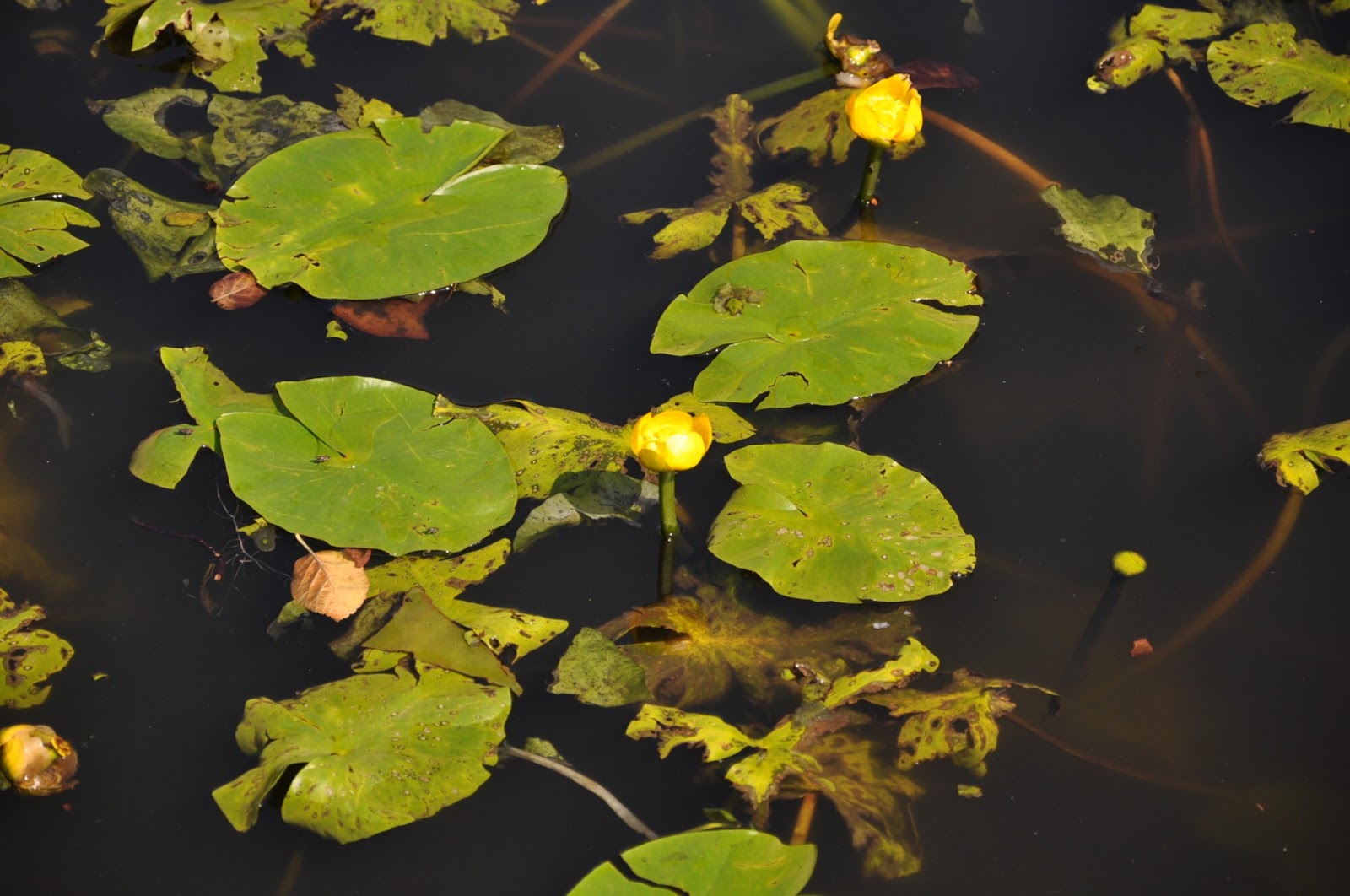
Nuphar lutea (brandy bottle) flowers

Rather obviously, this subject leads into having a look at brandy bottle, the native water lily with the largest leaves. Cornus sanguinea 'Winter Flame' with its attractive fire-like winter stems is another contender, as is  burning bush (Dictamnus albus), an attractive perennial producing an aromatic oil which can be ignited in hot weather. Hold a match near it in the right conditions, and the whole plant goes up with a flash. This was suggested to be the burning bush mentioned in the bible and so has religious interest. However, using it as an educational tool for demonstrating this remarkable property doesn't do a lot for your herbaceous border.

The Latin name for brandy bottle is Nuphar lutea. Nuphar comes from Persian nufar meaning Nymphaceae - the water lily family - and lutea means yellow, referring to its flower. This is not really one to be recommended if you only have a small pond, because of the size of its leaves (about sixteen inches across), and deep water preference (can live in fifteen feet of water but will tolerate less). The common name relates to the seed pod remaining when the flower is finished, although as to what era brandy bottles were that shape I'm not sure.

The 'brandy bottle' seed capsules

Frog-bit (Hydrocharis morsus-ranae) is a much smaller native water plant and therefore more suitable for the majority of garden ponds. It proliferates quickly but is easy to control, as it floats on the surface and can be fished out with a net. However, it is classed as an invasive plant in Canada and some North American states. I have actually seen a frog sitting in the water under a frog-bit and looking for all the world as if it were wearing a beret. Perhaps it was French and perhaps also it was an incident like that which inspired someone to call it frogbit. They overwinter as buds in the mud at the bottom of the pond and it is as well to note this so you're not tempted to indulge in the mania for 'cleaning out the pond' which results in the loss of these plants as well as that of a number of other forms of wildlife including some frogs. When the bud warms up in spring it grows, using stored food, and the subsequent loss of weight causes it to pop to the surface. As well as being aesthetically pleasing, the plant is useful in that, like lilies and pondweed, it cuts out light from the surface and so, to some degree, limits the growth of algae. It has separate white, three petalled  male and female flowers which emerge from  spathes like the one  visible towards the bottom of the photo. The males have short stems and the females are supported on longer ones. They usually open in July, so the one in the picture just taken is yet to emerge.

So, having travelled from hot cars to frogs, I rest my case for this week.


Frogbit. The spathe at the bottom of the picture is where the flower emerges.


Saturday, 2 February 2013

Impatiens glandulifera (policeman's helmet)

One-Way Weeds


Impatiens glandulifera with gatekeeper butterfly


I think I've mentioned before that I used to have an old post office Morris 1000 van. I had a strict maintenance schedule for GPO vans and this was to run them til they stopped and then get another one. Having said this, I did perform occasional highly technical repairs. For example the radiator on this particular one leaked and someone had told me you could solve the problem by putting an egg in. This led to a pleasant smell of cooking in the vehicle but the efficacy wore off after about fifty miles, meaning a new egg was required on a regular basis. I always used free-range, so this was pretty environmentally responsible for the time and there was always a carton of them under the dashboard. Eventually the system got completely blocked with what I suppose, in culinary terms was poached egg, and I forget what happened after that. I've a suspicion I did an unsuccessful experiment to see whether you can run a car without a radiator, but merciful old age memory has blocked out the result.

I was driving down Oldham Road in the van one day and made a left turn down a fairly narrow street. My wife was with me and she suddenly screamed. This over-reaction to  my driving was fairly common in those days and, come to think of it, has steadily got worse. More so when  my daughter is also on board because this means there are three drivers. Anyway, I suppose on this occasion she had some justification, because a policeman was crossing the road in front of us, looking the other way.

"Bloody hell", I yelled, jamming on the brakes "you'd think a copper'd have more sense".

At this point the policeman turned round, saw the egg-laden bonnet about three feet away and, for some reason, jumped in the air. I often think back to the way his helmet came down two seconds after he did,    and have come to the conclusion there must be some law of physics that explains this. Then I realised he was crossing the road at pedestrian lights facing the other way. The evidence was purely circumstantial, but it seemed to point to the fact that this was a one-way street and, more than likely, I wasn't going the recommended one.

The officer of the law banged imperiously on the driver's side window, not looking very pleased.

"Park up over there", he instructed, when I wound the window down, so I pulled over and got out. Its worth pointing out that the van wasn't in the best of conditions: one wing mirror was loose and it rotated slowly when the vehicle was moving, giving a wonderful view of what was in the shop windows but being a bit neglectful of what was actually behind on the road; the engine started when it felt like it, which wasn't often enough for my liking, and various other defects showed up intermittently. No doubt there is another blog in there somewhere. Anyway, the policeman leaned on the back of it and read the riot act.

Another aspect of the van that was a bit defective was the handbrake, and the weight of the arm of the law leaning caused  it to start moving. However, it stopped before he noticed, because my quick-thinking wife had leaned across and pressed the foot-brake. Even then he could have had me when the brake lights gave us away, but luckily they hadn't worked for some time.

He had a considerable rant, informing me I'd taken ten years off his life and giving the impression that going the wrong way up a one way street was subject to the death penalty. I thought he'd throw the book at me but he didn't. For some reason he seemed to be a bit of a nervous wreck and gave me the impression he wanted me out of his sight.

"Bear that in mind and now bugger off", he said when he ran out of rant. I felt quite indignant really. What had happened to police politeness when addressing members of the public?- surely I was entitled to a 'sir' and this was the police brutality they talk about. Maybe I should report him. Police on the telly never used bad language like that (not in the seventies, anyway). Even when a murderer is being arrested they refer to him as 'sir'. He had gone a funny red colour though, and he had nearly been run over, so I thought it best not to pursue the matter. On reflection, I suppose he may have had a point.

 I got back in the van and tried to start the engine. It wouldn't.

The friendly constable stood watching, and I swear he went a deeper red than the traffic light when I had to ask him for a push. It was alright though, I was used to this. With him and my wife pushing and me running and shoving alongside, steering through the open door  until we reached speed, I was able to dive in, ram it into gear, and roar off, leaving Plod looming through a cloud of black exhaust smoke. He looked a bit like Clint Eastwood in that scene in 'A Fistful Of Dollars' and I got the impression he'd have liked to blast me to oblivion, like Clint did with the baddies. He looked even worse when I did a three point turn and came back.  It was a one way street, after all.

Not surprisingly, this incident reminded me of policeman's helmet (Impatiens glandulifera), that ubiquitous weed of damp places. It was first introduced by the early Victorians as an attractive garden plant. One of those things that seemed a good idea at the time. Now it is rampant along river banks throughout the country, out -competing native plants for light and nutrients and making some places inaccessible. At times it can reach a height of 9ft.

Called policeman's helmet because the flower is the same shape as its namesake, it is also known as Himalayan balsam, with reference to its place of origin, and is closely related to the busy Lizzie we grow as bedding. The reason it has taken hold so successfully can be seen in its seed pods: the plant forces water into them until the pressure is so great that they explode. Sometimes even a fly landing on one can set it off, sending seeds as far as twenty feet away. This gives it tremendous potential to exploit new ground and also probably explains a preponderance of flies on crutches in the vicinity.

Explosive seed capsules


Much disliked for the reasons outlined, balsam bashing days are organised in many places, the object being to destroy the plants before they set seed. However seeds are viable for a couple of years, so only regular 'bashes' are going to make an appreciable difference.

On the positive side, the flowers are attractive and bees love them, climbing out positively plastered with pollen and, if you look closely, smiling. In addition to this, all upper parts of the plant are edible for humans.

Bee emerging from flower

Coming back to one-way streets: maybe the policeman's helmet and various other alien plants are destined to move inexorably forward until the day comes that we forget they're foreigners. It's happened with sycamore, conker trees and many more, so why not? Be nice to think that the people of different nations will eventually blend in the same way.

Roll on one world.

Saturday, 26 January 2013

Water Lilies

Lilies and Bikes
A friend told me an unfortunate story the other day: his wife had suggested they go for a walk, as the weather was nice. However, he'd got a bad knee and didn't fancy that but suggested a bike ride instead. I didn't quite follow the logic of this, because I'd have thought knees are exercised pretty vigorously on a bike. Be that as it may, the conversation continued along the lines of:

"I'm not that good on a bike. Still a bit wobbly."

"Well, the way to improve is through practice. Tell you what - we'll go along the canal bank."

Now, it may only be me, but it seemed that this conversation was moving in the same way as the build up to  Towering Inferno or Titanic and you couldn't expect a big prize for guessing the ending.

"Alright then," she said dubiously, "I'll follow you".

So they set off and for some time all was well. Then my mate, who is a keen birder, suddenly stopped and pointed across the canal.

"Buzzard", he said.

His wife, more intent of staying upright, forgot where the brake was and ran into the back of him. Then, in his     words: 'unable to free her feet from the pedal clips, she wobbled towards the canal in slow motion. It was almost artistic, like a scene from a David Lean film'- at this point his eyes glazed with the memory - 'then she careened over the edge, at one with the bike. The water closed over them and I stared in dismay. A good few seconds later, the now still surface was broken as the bike slowly rose, held in white knuckled hands and bringing to mind the presentation of Excalibur by the Lady of the Lake.'

"Thank God," he said in relief, "that's a new bike".

When the Lady of the Lake eventually emerged, the poetry of the situation dissolved somewhat:

"Well", she said through clenched teeth,  dripping mud and frog spawn and squinting through a curtain of bedraggled hair, "the next time you see a bastard, you don't need to stop, because  I don't give a shit".

"Buzzard", he corrected miserably, but under his breath. In these situations you need to know when to stop.

His wife's name isn't Lily but it was her situation that led me to think of how we can easily overdo the planting of our ponds. If you are keen on wildlife it is sometimes a temptation to go overboard with native plants, following the line of thought that these will be a greater attraction to other forms of life. In this case though, it may not be a good idea unless you've got a sizeable pond: the white flowered Nymphae alba has big leaves that spread to about six feet and end up forcing each other into a jumble which completely hides the surface of the water. When flowers appear, they are often lost in the mass of greenery. Similarly the yellow flowered Nuphar lutea has even larger leaves and needs plenty of space. Its common name is brandy bottle, because the seed head looks like the old fashioned containers. Another native, Nymphoides peltata, the fringed water-lily, has small leaves and yellow flowers, making it more suitable for a small pond. It has a tendency to spread but is easy to thin out. With much the appearance of a water lily, it is botanically classed differently.

Nuphar lutea (brandy bottle) - flower

Nuphar lutea (seed head)

If you have a large pond, the world is your oyster, choice wise. However, many varieties share the size problems of the natives, so it pays to do a bit of research: dwarf varieties make it possible to grow water-lilies in the smallest of situations, such as half-barrels. Nymphaea 'Pygmaea Helvola' is a good example. With yellow flowers, its spread is around a foot to eighteen inches,dimensions it shares with a number of other varieties.

Display of water lilies at Bodnant Gardens

Another important consideration when planting water lilies is the depth of the pond. Some of the larger forms will only thrive in two or three feet, whereas smaller forms require considerably less. The depth should be increased once the plant is established, so that it is receiving optimum light in the earlier stages of growth. This is best done by standing the basket on bricks and gradually removing them until the optimum water covering is achieved. Plant labels are now informative enough to outline the specific depth required and the ultimate size of the variety chosen.

Lilies not only add to the aesthetics of a pond, they restrict light to the area underneath and algi, the stuff that causes cloudiness, needs light to thrive. This is not the complete answer to algi - only a component, so we'll have a look at supporting remedies in a later blog. At the same time, I'll update you on my mate's marriage.


Saturday, 29 December 2012

Organic Pest Control

Garden Problems

      The sex lives of worms seemed to capture the interest of quite a few people and this has led me to look a bit more closely at the private goings-on of other common garden denizens: top of the list must be slugs. Like worms, slugs are hermaphrodite, meaning that each one has both male and female sexual apparatus. Do-it-yourself however is not on their agenda, and two slugs making out will twine round each other in sexual bliss, exuding slime and  romantically muttering sweet nothings about things like cabbages and sprouts. In the case of the great grey slugs, this can go on for two hours before, in a fervour of excitement they consummate the act, hanging on the end of a length of slime suspended  from a handy shrub: a sort of slug equivalent of position 98 minus the wardrobe. They then both go away, smiling beatifically, and lay a cluster of little pearl-like eggs.

      Now, while all this is perfectly true and explains the frightening proliferation of slugs, it has little to do with the subject of this blog. It did get you reading though, didn't it?

Slug on the prowl


      A lady called Beth contacted me to ask whether I could suggest non-chemical pest controls in the garden, as she is trying to grow vegetables organically. A few things spring immediately to mind: nettles, soaked in water for a couple of weeks, yield an effective, though smelly, mixture good for controlling aphids (greenfly and blackfly), at the same time as acting as a fertiliser; rhubarb leaves (boil 3lbs for half an hour in 6 pints of water with a few soap flakes to aid adherence), provide another useful aphid control - then use the stems to control constipation; the dried, powdered leaves of rue (Ruta graveolens), spread on seedbeds, are said to deter birds and other seed eaters and rubbed through the coats of dogs and cats will get rid of fleas; even the ubiquitous marestail can be used as a tea to protect against blackspot and mildew, while soft soap is used to kill brassica whitefly and cabbage white butterflies. Apparently it acts as an enema so I suppose, like Elvis, they die on the toilet.

      This brings me back to slugs, as they must top everyones' pest list: while pellets containing metaldehyde are effective, there are ongoing concerns about the outcome when natural predators like hedgehogs and birds eat the corpses. On the other hand, slugs drowned in a beer trap (a) die happy - their eyes are still going round the following day - and (b) their corpses do no harm when placed on the bird table, although a blackbird may occasionally fly into a lamp-post. However, Gardening From Which worked out, some years ago, that, to completely eliminate slugs, you need a beer trap every couple of square feet. This means that, unless you have shares in a brewery, it's going to be a pretty expensive project. You should also know that slugs in posh areas prefer gin and it, while milk is popular in the American bible belt.

Slug Eggs

      Nematodes provide an effective alternative to beer: these are microscopic eel worms provided in a pack containing enough to protect a forty square metre plot for about six weeks. They are watered on. Unfortunately the effect on snails is not quite as good, because these slugs-with-caravans tend to move from plant to plant above ground, rather than making contact with the soil. Copper bands, available in garden centres and wrapped tightly round pots, cause an electric current to be created through contact with a slug's slime, resulting in them getting a shock and falling off . This doesn't actually kill them, but it certainly removes Hostas in pots from the menu. A couple of copper wires, used in the same way, can be equally effective. Additionally, a tea made from Artemisia and watered on is also claimed to deter slugs and snails, although I haven't actually tried this one.

Slug pub with inebriated customers

      The more I write on this subject, the more information comes to mind (thanks for the question, Beth), so more blogs will be devoted to garden problems and how to control them. I can even see the sex life of the aphid looming on the horizon.

      Calm down. You'll have to wait.

Saturday, 13 October 2012

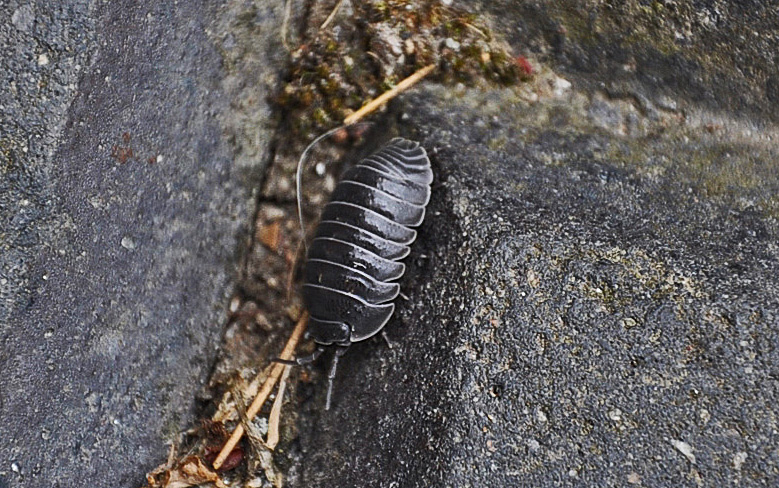
Woodlice - Friend or Foe?

What harm do they do?

      Woodlice are one of the commonest, or at least most easily seen, residents of the garden. They occasionally do a bit of damage in the greenhouse by having a nibble at young seedlings but established plants are not bothered by them. Their presence is more a criticism of the gardener for presenting them with good living conditions in the form of places to hide.
     
      It seems a shame that, because something has more legs than us, the reaction of many people is 'how do I kill 'em?' The fact is that woodlice mainly eat dead organic matter. This means that they are  part of nature's wonderful recycling system whereby this food is reduced, along with the work of other organisms, to compost. The compost enables more plants to grow and is an example of how even the smallest, seemingly insignificant, creatures play a much more positive role in preserving life on Earth than we do, with our polluting, resource- exhausting ways.


      They crawled from the sea millions of years ago and since then haven't evolved much: still breathing through gills, they will usually be found in damp places, under stones or rotting leaves, where they can retain a 'skin' of water. Apparently these gills are in their knees, which probably means they aren't religious because, in kneeling to say prayers, they will asphyxiate themselves. Ancient relatives, a foot in length, can still be found 6,000 feet down in the Atlantic and The Sea Life Centre in Blackpool have some on show. There are many different species frequenting gardens but basically they share the same characteristics, apart from the foot long bit.

      My selection of wildlife pictures includes quite a few of insects mating, leading my wife to label me an insect voyeur. Sadly I have none of woodlice in a compromising situation. The closest I came was when on holiday in Presteigne, on the border of Wales: I was walking along a lane about the width of a car. The sides were banked and full of wildflowers, while in the distance a cuckoo was calling. The sunshine and blue skies seemingly completed this idyllic picture until my senses reached even further heights when, rounding a corner, I came across two woodlice in flagrante delicto  on a vigorously bending blade of grass. My excitement was even greater than theirs: I fixed my camera on the tripod, focused, adjusted for depth of field and was about to shoot when their exertions overcame them and they fell off.


      Some species of woodlice were called pill bugs in days of yore. This was because, when touched, they roll up in a ball. People suffering upset stomachs would swallow one in order to clear up the problem.

      Might be worth a try.

Wednesday, 29 August 2012

Garden Wildflowers

Wildflowers In The Garden

'If it's a native of this country it'll be a doddle to grow it', seems a logical way of thinking about wildflowers. However, though we are expert at growing exotic things like Dahlias and a multitude of other species, we often fall short in our ability to grow something that proliferates in our own countryside (unless we think of marestail and dandelions - I'm the world champion at them without even trying). One of the main showgrounds of wildflowers is the field regularly cropped by  the farmer for hay. The reason for this is that each year the grass grows, using up nutrient from the soil. Then it is cut and removed for use on the farm, leaving a soil progressively less rich in nutrients - especially nitrogen. This is a boon to the wildflowers, because grass thrives on nitrogen and is subsequently less able to out -compete the other plants.


Hyde Hall Wildflower Meadow

Bearing this in mind, our wildflower patch should not be treated to the constant addition of organic matter and blood, fish and bone butties so loved by the foreigners, but actually allowed to become depleted of these goodies. Copying the hay farmer is one way of achieving this, but obviously that takes time, so it is sometimes recommended that we remove the topsoil to a depth of about six inches and plant in the relatively poor subsoil. This can be a massive task on a large plot, so the slower method may be used and helped along by the use of plants like hay rattle, which is semi-parasitic on grasses and consequently weakens them. An attractive plant in its own right, the ripe seeds do actually rattle when the pods are shaken. Other help is also at hand in places like The National Wildflower Centre in Court Hey Park, near Liverpool, where they display different growing techniques and mediums, while also offering courses and adult training.


Hay Rattle
Anyone not convinced about the merits of wildflowers should visit gardens like Harlow Carr in Yorkshire and Hyde Hall in Essex, where the displays can be mind-blowing. However, for me, the advantage of wildflowers is not simply in the aesthetics they provide, but in something far deeper: for example, at Fletcher Moss where I used to work, we changed the mowing regime in the meadow from fortnightly to once a year in late summer. The result was a proliferation of cuckooflower (Cardamine pratensis). However, not only did we get the pretty flower but it was soon noticed that there were far more orange tip butterflies around. Orange tips rely very much on cuckooflower for feeding and egg laying, so the wildflower had encouraged the insect. If there are plenty of insects, birds are attracted to feed on them and if these insect-eating birds are around, there is also the chance that their own predators, like sparrowhawks and kestrels will be attracted.


Cuckoo Flower
Orange Tip Butterfly


And so we learn the lesson that all living things depend on other living things and the more we garden with nature rather than opposed to it, the richer our experience of the natural world will be.