Sunday, 23 September 2012

Moth Orchid (Phalaenopsis)

Living Frugally
Yew Growing On Rock

‘Outdoors, grow in fertile, well- drained soil in full sun.’ – this is a direct quote from a gardening book and it is referring to Buddleia. Now have a look at a derelict site and see the them growing through tiny cracks in concrete. Similarly, you can see the way they thrive in the mortar twenty feet up an old wall, accompanying the willow growing from the side of the chimney pot and the elderberry thriving in the gutter. My point is, that plants grow where they want, not having read the gardening books. If mankind were to be wiped out by some catastrophe, you can bet your life that in very few years signs of our civilisation would disappear under a forest of growth. The annoying thing, however, is that you can sometimes give the things 'perfect' conditions and they repay you by snuffing it.

Fig Tree Growing In Vertical Wall
 
While the Buddleias and others are simply opportunists, some plants have adapted to grow in what, to us, are poor conditions but for very good reasons. The moth orchid (Phalaenopsis) is a prime example and one useful to know about because it is probably the country's favourite houseplant. Its native habitat is in forests in the Himalayas, South East Asia and Northern Australia and, on the ground, the light is very poor due to the trees having filched it on the way. As this orchid, like most other plants, needs sunlight to photosynthesise the sugars which give the energy for growth, this presents a problem. It is solved by hitching a ride to the sun:  the plant simply grows on niches on the branches of trees, thriving in a compost of dead leaves and twigs, possibly enriched by the occasional bird-dropping butty.
Moth Orchid (Phalaenopsis)
 
Knowing about this native background gives us the logical make-up of a compost to grow the plant in: it should be airy, well drained and not too rich in nutrient. With this in mind, I usually make up a mixture of small broken birch twigs from the trees at the end of the garden, mixed with moss, a bit of leaf-mould and possibly some perlite. It may be interesting to further emulate natural conditions by encouraging the budgy to have the occasional bowel movement into the compost. However, teaching it the accuracy of a bomber pilot may take some doing. Another aspect of the natural habitat of this orchid is that it can be dry for long periods, highlighting how so many people manage to kill them - they over water.
The white aerial roots are capable of taking in water, so occasional spraying of these will relieve the stresses of a centrally heated room. They are a good indicator of the health of the plant and if they start to go brown, cut back on the watering and make sure it isn't standing in water. While most books recommend the addition of a high potash feed (tomato feed will do), I usually give a weak feed of a balanced fertilizer about once a month. An annual re potting is a good idea but resist the temptation to over pot - these plants thrive on a minimalist approach.
 

Friday, 14 September 2012

Climbing Plants

Be Adventurous

In the cause of scientific research, my youngest son leaned across his sister and opened the car window. This could be seen as being pretty unremarkable, except that we were going through a car-wash at the time. The findings of the experiment were: a. that bedraggled sisters pack a surprisingly hard punch and b. angry dads can affect ones finances by withholding pocket money.

It must be in the genes. My own experiments, this time in the seemingly safe environs of the garden, have sometimes proved to be equally disastrous. I feel strongly that the long list of rules the 'experts' compile are there to be tested. The garden is a personal art project and to be told that certain colours only work with certain other colour, or that, due to the current fashion, a particular plant is not to be used because its out of favour, is a bit of an imposition. You only need to look at how nature ignores all the rules in the countryside and comes up with stunning effects.

We had a bare patch of wall immediately next to the front door and I felt the front of the house would be improved if the hardness of the brickwork were to be relieved by some greenery. With this in mind, I set to and broke out a rectangle of concrete path to create a small bed against the wall. This was then planted with Virginia creeper ( Parthenocissus tricuspidata 'Veitchii'). It didn't require any trellis for support because the plant climbs like Spiderman, with little suckers which will stick to anything, including glass. This worked really well: in the summer the greenery did its job and was then followed by fiery autumn colour. The limitation, as I saw it, was that it is a deciduous plant, losing all its leaves in winter and leaving the wall looking as boring as it did originally. To remedy this, I planted a variegated ivy (Hedera helix 'Goldheart') about a foot away from the creeper. My idea was that, when the Parthenocissus lost its leaves, the brightness of the evergreen ivy would give the wall interest throughout the winter.

"You can't do that", said my sage gardening friends, as a man, "one of 'em 'll out compete the other for water and nutrients, leading to the weakest snuffing it".

However, in some ways, this experiment was a resounding success. Both plants grew with a competitive vigour that surprised us all. Unfortunately, they didn't know where to stop: a visit into the loft showed how ivy is happy to grow in extremely poor light conditions, while the creeper made its way round the front of the house and demonstrated its expertise in clinging to glass by colonising the bedroom window. Impervious to my argument that this could do away with the need for curtains and all the messing about they entail, my wife insisted I do something about it by 'cutting the damn things back." This, I think, is why there are more men scientists than women. Anyway, I climbed the ladder and cut it back to about two thirds up the wall. Unfortunately this became an annual necessity and, as I'm not keen on ladders and my wife is relentless when it comes to curtain substitutes, I eventually dug the whole lot out. On the positive side, I'd proved the experts wrong.


At our previous house, there was an unsightly telegraph pole actually touching our garden wall. I decided to test the properties claimed for Russian vine in being good at hiding eyesores, by planting one at the base of it. Again, this worked wonderfully, quickly and completely masking the pole. However,  I began to worry when it decided the pole wasn't enough and started to explore the potential of the wires emanating from it. As we were always telling the children, 'it's knowing when to stop'. The road was beginning to take on the look and feel of the Amazon rain forest when I solved that one. We moved.

Saturday, 8 September 2012

Garden Therapy

Heartbeat

It's hard to put your finger on what it is that makes being in countryside or in a garden more pleasurable than being in other settings. The best explanation I can put to it occurred many years ago when I was on a walk somewhere in the Macclesfield Forest area: it was a hot day and I'd walked a long way, so I lay down on  pine needles to rest.This was the perfect place to relax - it was completely silent.

At least I thought it was. However, after a few minutes of this 'silence', I realised it was far from that: the wind through the treetops was making a sighing sound not unlike that of waves on the shore; a curlew's liquid call drifted along the valley and, somewhere in nearby undergrowth a large insect or small mammal made foraging sounds. The more I tuned into what had been there all along, the more there was to hear. And this is what I came to refer to as the heartbeat of the earth. It outlined how my own 'reality' was very limited - restricted within a space helmet of my own making. Tuned into the heartbeat  I become part of something far greater:  my own life acquires a new perspective - problems are reduced when seen against the infinity of creation and, as a result, I feel peace.

The thing is, you don't need to be in the middle of the countryside to appreciate this good feeling, it can be achieved in the garden. The gardener is a control freak, and a relaxed walk around far too often becomes a listing of jobs: weeding here, plant supporting there, pest controlling somewhere else, and so on. Occasionally, try to just be there.
 
 
click to enlarge

Wednesday, 29 August 2012

Garden Wildflowers

Wildflowers In The Garden

'If it's a native of this country it'll be a doddle to grow it', seems a logical way of thinking about wildflowers. However, though we are expert at growing exotic things like Dahlias and a multitude of other species, we often fall short in our ability to grow something that proliferates in our own countryside (unless we think of marestail and dandelions - I'm the world champion at them without even trying). One of the main showgrounds of wildflowers is the field regularly cropped by  the farmer for hay. The reason for this is that each year the grass grows, using up nutrient from the soil. Then it is cut and removed for use on the farm, leaving a soil progressively less rich in nutrients - especially nitrogen. This is a boon to the wildflowers, because grass thrives on nitrogen and is subsequently less able to out -compete the other plants.


Hyde Hall Wildflower Meadow

Bearing this in mind, our wildflower patch should not be treated to the constant addition of organic matter and blood, fish and bone butties so loved by the foreigners, but actually allowed to become depleted of these goodies. Copying the hay farmer is one way of achieving this, but obviously that takes time, so it is sometimes recommended that we remove the topsoil to a depth of about six inches and plant in the relatively poor subsoil. This can be a massive task on a large plot, so the slower method may be used and helped along by the use of plants like hay rattle, which is semi-parasitic on grasses and consequently weakens them. An attractive plant in its own right, the ripe seeds do actually rattle when the pods are shaken. Other help is also at hand in places like The National Wildflower Centre in Court Hey Park, near Liverpool, where they display different growing techniques and mediums, while also offering courses and adult training.


Hay Rattle
Anyone not convinced about the merits of wildflowers should visit gardens like Harlow Carr in Yorkshire and Hyde Hall in Essex, where the displays can be mind-blowing. However, for me, the advantage of wildflowers is not simply in the aesthetics they provide, but in something far deeper: for example, at Fletcher Moss where I used to work, we changed the mowing regime in the meadow from fortnightly to once a year in late summer. The result was a proliferation of cuckooflower (Cardamine pratensis). However, not only did we get the pretty flower but it was soon noticed that there were far more orange tip butterflies around. Orange tips rely very much on cuckooflower for feeding and egg laying, so the wildflower had encouraged the insect. If there are plenty of insects, birds are attracted to feed on them and if these insect-eating birds are around, there is also the chance that their own predators, like sparrowhawks and kestrels will be attracted.


Cuckoo Flower
Orange Tip Butterfly


And so we learn the lesson that all living things depend on other living things and the more we garden with nature rather than opposed to it, the richer our experience of the natural world will be.

Sunday, 26 August 2012

Hedges

Hedge Your Bets

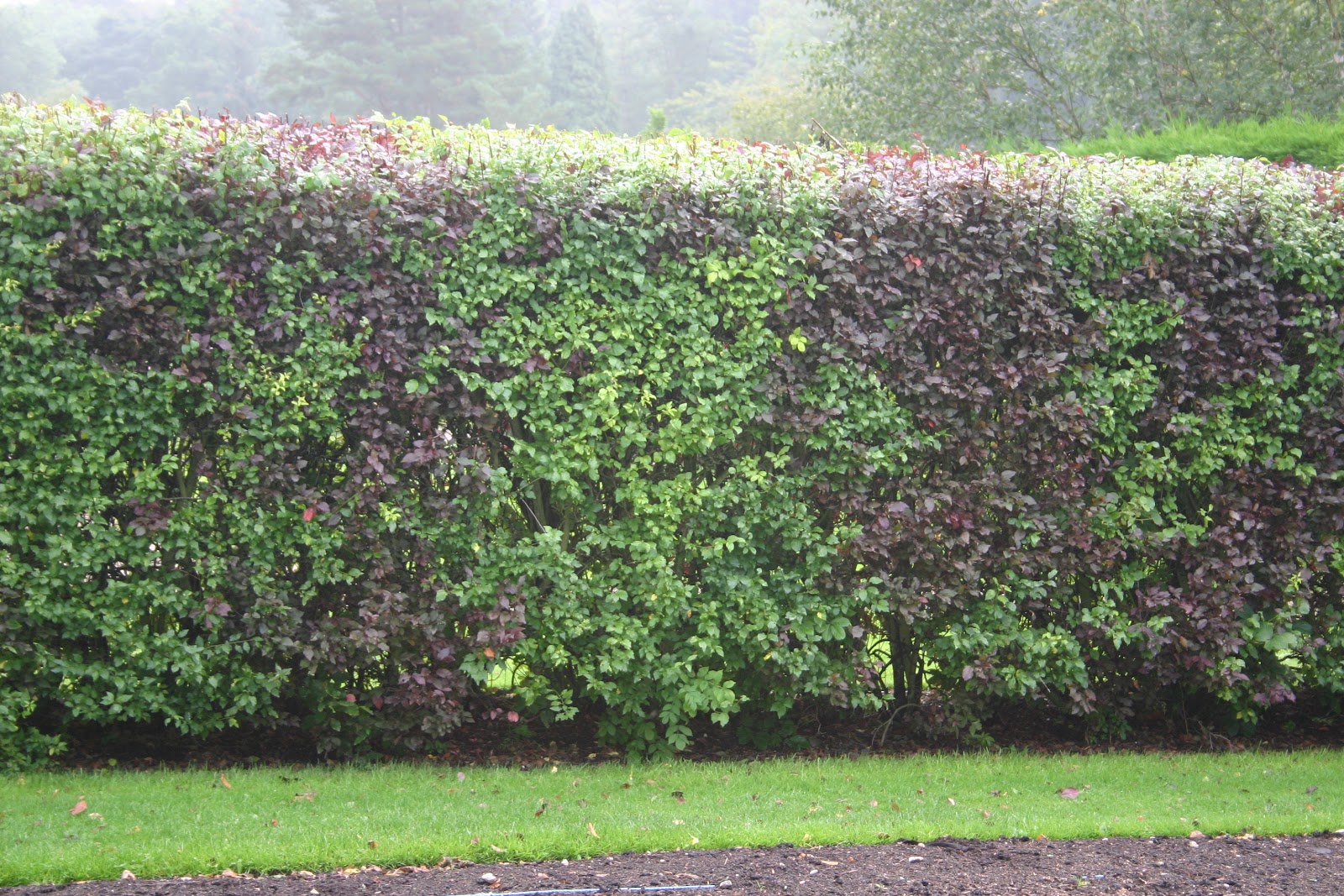
There are really very few hard and fast rules about gardening. Take hedges, for example: people think of them and perhaps privet comes to mind, or hawthorn, or beech or..... well, you get the idea. One of the most effective hedges I've come across was in a council house garden in Manchester. Instead of consisting of just green privet (like the rest in the street ) it was a mixture of golden privet and beech. This had the effect of creating a contrast between the yellow of the privet and the green of the beech in summer. In winter the beech leaves die but remain on the plant, giving a new contrast of yellow against a warm brown, so that there is a year-round colour interest combined with privacy. This sort of effect can be copied by planting variegated plants and different coloured conifers. The only thing to beware of is that the chosen plants have similar growth rates, avoiding the creation of something that looks like the North Sea on a bad day.

Yew and variegated holly (click to enlarge)
 
Purple and green beech


  Another way of adding interest to a yew or Chamaecyparis hedge is to grow a climber up it which will give some colour variation. The classic example of this is the flame creeper (Tropaeolum speciosum), which follows flower colour with attractive blue fruits.


flame creeper


flame creeper fruit


It is worth understanding what is happening when you cut a hedge: put simply, the plants used are trees, and the leading shoot of the tree has the object of competing with other trees for light. To improve its chances of getting above the others, it sends a hormone down to lower laterals which inhibits their growth, enabling it to forge ahead. If you cut the hedge, you remove that leading growth and the supply of inhibiting hormone stops, enabling the lower branches to grow, so that they bush out to give a nice thick barrier.  

We've all noticed the lovely conifer hedge which suddenly goes brown and we come to the conclusion that its got some dread disease. In some cases this is true but often the 'dread disease' is the comedian who has trimmed it back into old wood. Most conifers, yew being an exception, don't regenerate from old, inner wood, so beware of being too enthusiastic with the shears. Beware also of the cowboy who comes to your door offering to 'do the garden'. 'Do' is the operative word in many of these cases, where this so called gardener doesn't know a rare orchid from an oak tree and is destined to devastate your conifer hedge.

Thanks for visiting and I would love to hear your feedback.

John


Saturday, 25 August 2012

Snail Problem

Mystery Culprit
     

      Hi, this is my first blog, I hope you find it useful, or at least interesting:

      A Clematis growing next to our front door was getting progressively weaker. There were a few holes in the leaves but this didn't seem to be the real problem and I thought that, in spite of going through a summer of record rainfall, the roof overhang was sheltering the plant and  causing dryness at the roots. So I watered it. This produced no change, so I tried slug control, with an equally dazzling lack of success. It was only by chance that I noticed, on returning home after dark one night, that the wall behind the plant had developed a pebble-dash effect. A closer look revealed the source of my problem: snails - about a quarter of the world population. They had bypassed my slug control by climbing around the wall from a bed at the front of the house and tended to be feeding on the outer parts of stems rather than leaves, preventing the movement of water, sugar and nutrients around the plant.

      This was a graphic example of why measures to control slugs often don't work with snails, because pellets, or the natural control using eelworms (Nemaslug), are used on the ground, while the snails are absailing onto the plants from somewhere else, laughing at the gardener's ignorance.

      Needless to say, this lot didn't laugh, although one did go WHEEEE! as it sailed across the road.